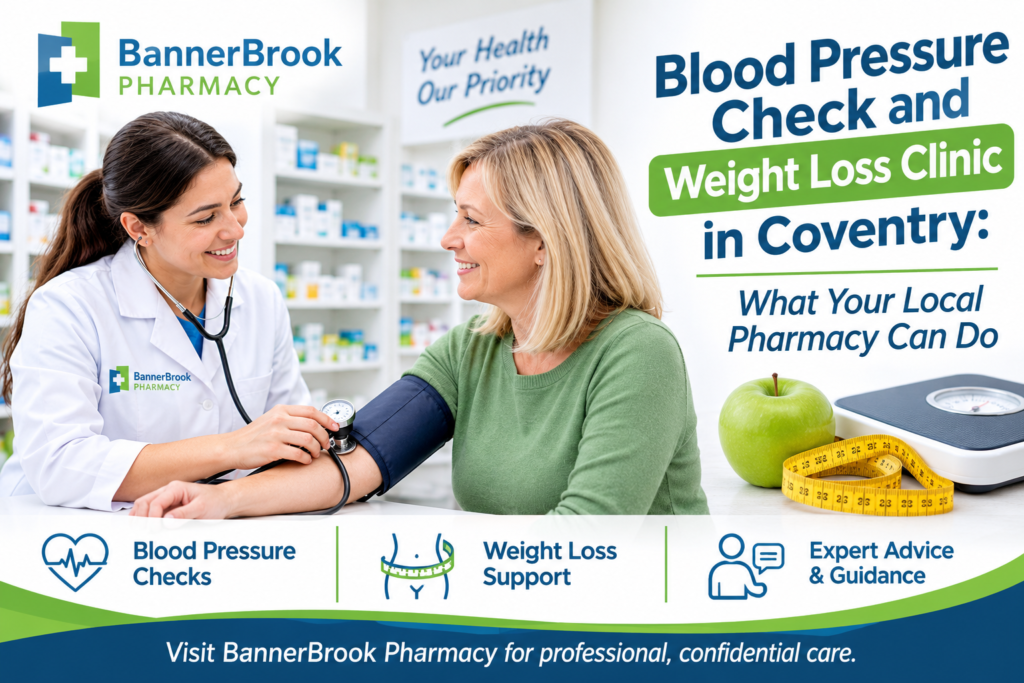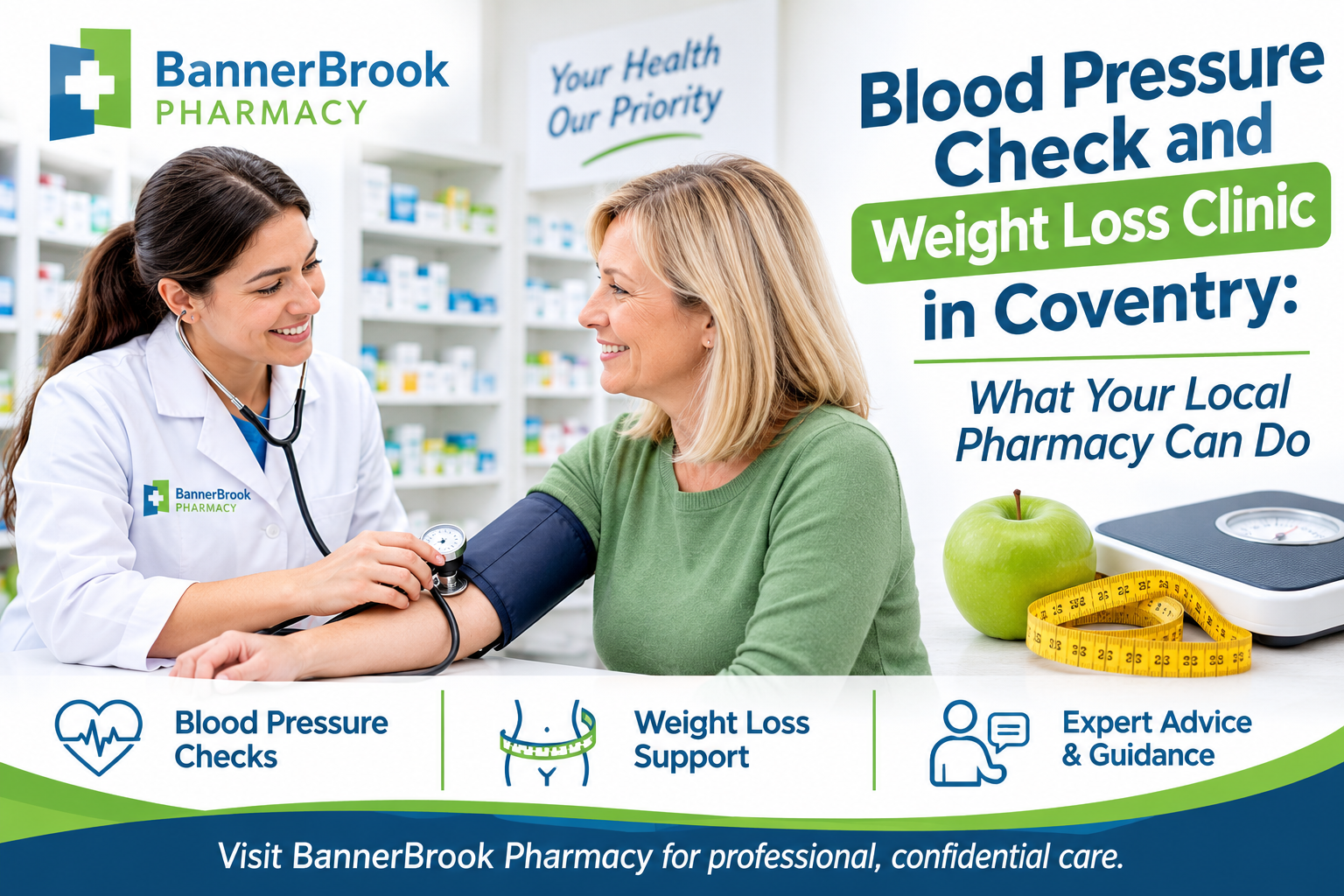
Free NHS blood pressure checks at Bannerbrook Pharmacy are for adults aged 40 and over who haven’t been diagnosed with high blood pressure and haven’t had a check in the last five years. Under-40s with a family history or higher risk may be seen at the pharmacist’s discretion. The check takes around 10–15 minutes and you don’t need to see your GP first. Our private weight loss clinic starts with a consultation covering a health check and lifestyle assessment, and prescription-only treatment is offered only if it’s right for you. Both services are at 5-7 Gramercy Park, Banner Lane, Coventry CV4 9AE, with late opening on weekdays and Saturdays.
High blood pressure rarely announces itself. For most people there are no symptoms at all, which is why a short cuff reading at a pharmacy can be the first sign that something needs attention. Weight works in a similar way: it creeps up quietly, and the health effects arrive later.
At Bannerbrook Pharmacy on Banner Lane, we offer both: NHS blood pressure checks for eligible adults, and a private, pharmacist-led weight loss clinic with consultations and follow-up. This guide explains who qualifies, what actually happens at each appointment, and why it makes sense to look at the two together.
Why blood pressure and weight belong in the same conversation
Carrying extra weight makes high blood pressure more likely, and high blood pressure is one of the conditions clinicians count as weight-related when they decide who needs treatment for obesity. The two tend to turn up together. The practical upside is that they respond to similar changes: for many people, losing weight brings blood pressure down.
That is why we treat them as connected rather than separate. A blood pressure reading gives you a baseline before you start a weight loss programme, and regular readings afterwards show whether the changes you are making are working. NHS campaign material has estimated that around 4.2 million people in England have high blood pressure without knowing it, so a baseline is worth having.
NHS blood pressure check at Bannerbrook Pharmacy
Our NHS blood pressure check is a quick, non-invasive screening carried out in a consultation room by a pharmacist or trained member of the team. It is designed to catch high blood pressure early, before it causes problems.
Who can have a free NHS check
The rules for the NHS service were tightened on 3 September 2026. You can have a free check if you are:
- aged 40 or over,
- not already diagnosed with high blood pressure, and
- haven’t had your blood pressure checked in the last five years.
If you are under 40, you may still be seen at the pharmacist’s discretion if you have a family history of high blood pressure or are at higher risk, which includes people of South Asian and African-Caribbean heritage.
If you are already being treated for high blood pressure, the pharmacy check is no longer open to you, because the service exists to find people who don’t yet know. Your GP practice remains the right place for ongoing monitoring. Not sure where you stand? Ask the team when you call or book and we’ll tell you.
What happens during the check
- You sit down and rest for a few minutes, back supported and legs uncrossed.
- A cuff is placed around your bare upper arm. You stay still and avoid talking while it inflates.
- Your blood pressure (and pulse) is recorded and you can usually see the result straight away.
- The pharmacist explains what the numbers mean and what to do next, including lifestyle advice.
- Your reading is sent to your GP practice so your record stays up to date.
Allow around 10–15 minutes in total. Calling ahead or using our online booking page helps avoid a wait.
What your reading means
Blood pressure is given as two numbers: systolic (when the heart beats) over diastolic (between beats), measured in mmHg. These are the ranges used for readings taken at a pharmacy, GP surgery or clinic.
| Reading | What it generally means | What usually happens next |
| Below 90/60 | Low. Often fine if you feel well. | No symptoms: recheck within a year. Dizziness, nausea or fatigue: speak to your GP. |
| 90/60 to 120/80 | In the ideal range. | Recheck at least every five years. |
| 121/81 to 139/89 | Higher than ideal. Could raise your risk of high blood pressure over time. | Lifestyle changes and more frequent checks, ideally yearly. |
| 140/90 or above (below 180/120) | High. | 24-hour monitoring is typically offered, and you’re advised to see your GP. |
| 180/120 or above | Very high. | Same-day medical advice. With symptoms, call 999. |
At home, the high-blood-pressure threshold is an average of 135/85 mmHg rather than 140/90.
One high reading does not mean you have high blood pressure. Nerves, a rushed walk in or a coffee can all push numbers up. That is why, under the NHS service, a high reading is typically followed by 24-hour (ambulatory) monitoring, where a small cuff takes automatic readings over a full day. Your pharmacist will explain how that works for you.
When a reading needs urgent attention
A reading of 180/120 or above needs same-day medical advice. If you also have chest pain, a severe headache, blurred vision, breathlessness or confusion, call 999. A very fast or slow pulse, or an irregular one, will also be flagged for follow-up.
Getting an accurate reading
- Sit quietly for at least five minutes before the cuff goes on.
- Keep your back supported, feet flat and legs uncrossed.
- Wear a loose sleeve you can roll up easily.
- Avoid caffeine, smoking and exercise for 30 minutes beforehand.
- Stay relaxed and don’t talk during the measurement.
Weight loss clinic at Bannerbrook Pharmacy
Our private weight loss service is pharmacist-led and built around safe, sustainable weight loss. The medicines regulator, the MHRA, is clear that weight loss medicines are not a quick fix, and our approach reflects that: assessment first, treatment only where appropriate, and follow-up afterwards.
What the consultation involves
- A health check and lifestyle assessment, including your medical history, current medicines and weight history.
- A decision on whether prescription-only treatment is suitable. If it isn’t, we’ll say so and talk through other options.
- Regular follow-ups and progress tracking if you go ahead.
- Private, judgement-free support from trained professionals.
You don’t need a GP referral to book a consultation. It helps to know your recent blood pressure readings, so mention them when you book.
Who may be suitable
In the UK, prescription weight loss medicines are licensed for adults with a BMI of 30 or above, or 27 or above if you also have a weight-related condition such as high blood pressure or type 2 diabetes. Meeting the BMI figure is only the starting point. Your pharmacist makes the final decision after reviewing your health.
These medicines are not suitable for everyone. They should not be used by people under 18, or by anyone who is pregnant, breastfeeding or trying to conceive.
How prescription weight loss injections work
The best-known prescription options are weekly injections that copy natural gut hormones (known as GLP-1 medicines). They help you feel fuller for longer and eat less, and some slow how quickly your stomach empties. Other prescription options work differently, for example by reducing the amount of fat your body absorbs. Which treatment, if any, is right for you is decided at the consultation.
Safety points worth knowing before you start
- Side effects. These are mostly digestive, such as nausea or changes in bowel habit. Read the patient information leaflet and tell us if anything worries you.
- Contraception. Tirzepatide-based medicines can make the contraceptive pill less effective. The MHRA advises adding a barrier method, or switching to a non-oral method, for four weeks after starting and for four weeks after each dose increase.
- Pregnancy. All medicines in this class should be avoided in pregnancy. Your pharmacist will explain how long to wait before trying for a baby.
- Other medicines. Weight loss can change how your body handles some medicines, so we review what you take.
- Where you buy matters. The MHRA warns against buying these medicines from unregulated sources. Use a registered pharmacy, and report suspected side effects through the Yellow Card scheme.
NHS or private?
NHS access to weight loss injections is phased and depends on your BMI and weight-related conditions. GPs in England have been able to prescribe in line with the national rollout since June 2025, and the criteria are due to widen over time. Local availability varies, so your GP is the best person to ask what is open to you. If you don’t meet NHS criteria, or you want a different route, a private pharmacist-led service is an option.
Medication supports habits; it doesn’t replace them
Food, movement and sleep still do much of the work, and the follow-up appointments are where that gets sorted out. Small, repeatable changes tend to last longer than strict plans, and your blood pressure readings are a useful, objective way to see progress.
Using both services together
- Get a baseline. If you’re eligible, have a blood pressure check before you start any weight loss programme.
- Share your numbers. Tell the pharmacist your readings and every medicine you take when you book your weight loss consultation.
- Keep taking blood pressure tablets. Don’t stop or reduce them yourself. As your weight changes, your GP decides whether your dose still suits you.
- Recheck as you go. At home, the NHS advises two readings at least a minute apart, morning and evening, for seven days, then averaging them.
Visit Bannerbrook Pharmacy in Coventry
We’re at 5-7 Gramercy Park, Banner Lane, Coventry CV4 9AE, which makes us convenient for Bannerbrook Park, Tile Hill, Cannon Park, Allesley and the wider CV4 area. Call us on 024 7642 2120, contact the team, or book an appointment online. You can also meet the pharmacists on our About Us page.
| Day | Opening hours |
| Monday to Friday | 8:30 am – 9:00 pm |
| Saturday | 9:00 am – 9:00 pm |
| Sunday | 9:00 am – 2:00 pm |
| Bank holidays | Closed |
Late weekday and Saturday opening means you can fit a check around work. If you’re unsure which service you need, start with a quick call. For more everyday health guides, browse our health blog or the FAQ page.
Frequently asked questions
- Do I need an appointment for a blood pressure check at the pharmacy?
Calling ahead or booking online helps avoid a wait. The check itself takes around 10–15 minutes, and you don’t need to see your GP first.
- Is a blood pressure check at the pharmacy free?
Yes, if you’re eligible for the NHS service: adults aged 40 or over without a diagnosis of high blood pressure who haven’t had a check in the last five years. Under-40s with a family history or higher risk may also be seen at the pharmacist’s discretion.
- What blood pressure reading is considered high?
At a pharmacy, GP surgery or clinic, 140/90 mmHg or above is considered high. At home, the threshold is an average of 135/85 mmHg. A reading of 180/120 mmHg or above is very high and needs same-day medical advice, or a 999 call if you have symptoms such as chest pain or a severe headache.
- How often should I have my blood pressure checked?
Healthy adults over 40 should have it checked at least once every five years. If you’re at increased risk, the NHS advises checking ideally once a year.
- Do I need a GP referral for the weight loss clinic?
No. You can book a consultation directly. A pharmacist reviews your health, medicines and weight history first, and prescription-only treatment is offered only if it’s appropriate for you.
- Who can’t use prescription weight loss medicines?
They aren’t suitable for everyone. They should not be used by people who are pregnant, breastfeeding or trying to conceive, and private services are for adults aged 18 and over. Your pharmacist will also ask about your medical conditions and current medicines before deciding.
- Do weight loss injections affect the contraceptive pill?
One type, tirzepatide, can make oral contraceptives less effective. The MHRA advises adding a barrier method such as condoms, or switching to a non-oral method, for four weeks after starting and for four weeks after any dose increase. Tell your pharmacist which contraception you use.
- Can losing weight lower my blood pressure?
For many people, yes. Losing weight often brings blood pressure readings down. Keep taking any blood pressure medicines unless your GP or pharmacist advises otherwise, and keep checking your readings as your weight changes.